
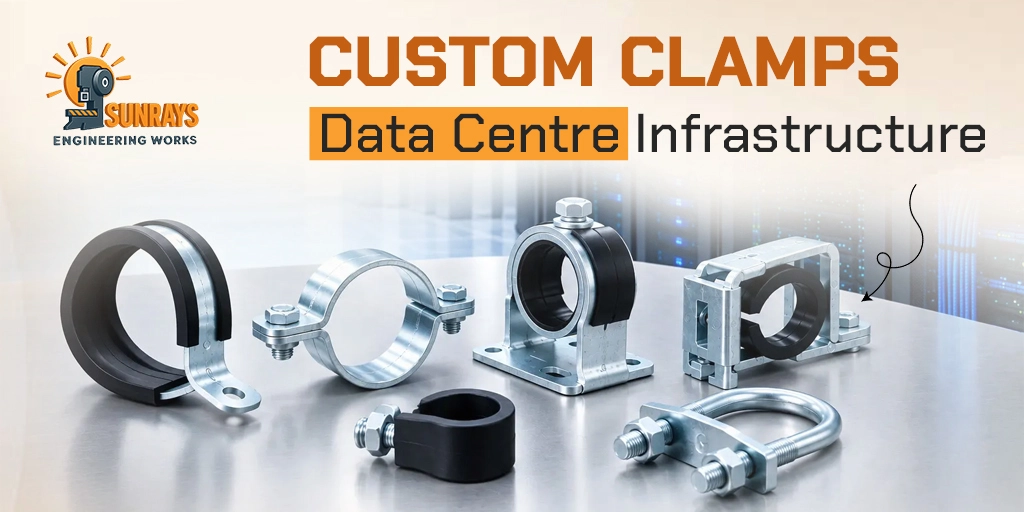
Data centre infrastructure keeps growing more complex as facilities accommodate higher computing densities, extensive power distribution, advanced cooling systems, and large volumes of network cabling. Servers and cooling equipment tend to get most of the attention, but the smaller mechanical components that support and organise these systems matter just as much to the overall installation.
Clamps are one of those components.
They secure cables, pipes, hoses, manifolds, brackets, and other infrastructure elements in defined positions. When a standard product doesn’t match the required diameter, mounting arrangement, clearance, material, or equipment interface, custom clamps for data centre infrastructure become the practical, application-specific alternative.
For data centre OEMs, EPC contractors, cooling-system manufacturers, infrastructure integrators, and industrial procurement teams, Clamps India offers a useful reference point for understanding where customisation genuinely helps and where a standard part will do the job. Clamps India works from this same principle across its manufacturing projects: the goal is always to match the component to the installation, not the other way around. This guide is written to help buyers communicate the right technical information to a manufacturer like Clamps India before requesting samples or production quantities.
What Are Custom Clamps for Data Centre Infrastructure?
Custom clamps are mechanical fastening or support components manufactured according to application-specific requirements, rather than picked off a standard catalogue page.
A standard clamp may already offer the diameter and mounting configuration you need. In other cases, though, the installation comes with constraints such as:
- A non-standard pipe or hose diameter
- A specific cable bundle size
- Limited installation space
- A particular mounting-hole position
- Required clearance from adjacent equipment
- A specific offset or angle
- A defined material or surface finish
- Protective or rubber lining requirements
- An OEM-specific mounting interface
In situations like these, a custom clamp can be developed around the actual component and the actual installation, rather than the other way around.
The objective isn’t to produce a different-shaped clamp for its own sake — it’s to create a component that genuinely satisfies the mechanical and installation requirements the buyer has defined.
Why Clamps Matter in Modern Data Centre Infrastructure
A data centre contains several systems that all need to be routed and supported in an organised way, including:
- Server and equipment racks
- Power distribution infrastructure
- Network and communication cabling
- Cable trays and pathways
- Cooling pipes
- Flexible hoses
- Liquid-cooling manifolds
- HVAC and ducting systems
- Equipment frames and brackets
The supporting components around these systems need to work with the physical environment they’re installed in. A cable, for instance, may need to follow a specific route without interfering with adjacent equipment. A cooling hose may need to stay securely positioned while still leaving enough clearance for inspection or servicing.
This is precisely where data centre clamps earn their place as part of a wider mechanical installation. The clamp itself is a relatively small component, but its dimensions and mounting arrangement directly affect how the supported component fits within the surrounding infrastructure.
How AI Data Centre Infrastructure Is Increasing the Need for Application-Specific Components
The growth of AI and high-performance computing is reshaping data centre design.
The AI data center infrastructure will incorporate the use of high density computing systems that require large amounts of power, extensive connectivity, and sophisticated thermal management solutions. Liquid cooling technology is also gaining increasing popularity in situations where air cooling fails to meet the thermal needs of high-density computing.
This results in more mechanical connections within the rack environment. For instance, an installation can have:
High-Density Cabling
Many artificial intelligence and high performance computing systems need lots of interconnectivity between computers, networks, storage, and power systems. Cable management must be done carefully within the equipment and pathways.
Liquid Cooling
Liquid-cooling systems can contain pipes, hoses, manifolds, distribution units, and connection assemblies — all of which need appropriate routing and mechanical support.
Equipment Mounting
Higher-density systems tend to mean more equipment and supporting components fitted into limited physical spaces, which raises the importance of compact, application-specific mounting arrangements.
None of this means every AI facility automatically needs custom clamps. But the more complex the physical installation becomes, the more likely engineers are to run into situations where a standard component simply doesn’t provide the required fit.
Where Custom Clamps for Data Centre Infrastructure Can Be Used
Custom clamps have applications across different parts of a data centre, and the appropriate design depends on what’s being supported and the conditions it will operate under.
1. Cable Management and Routing
Cable management is one of the most visible applications for clamping components. Power cables, communication cables, fibre-optic connections, and other wiring all need to be routed in an organised way.
Depending on the installation, custom clamps may be used for:
- Rack-side cable support
- Vertical cable routing
- Cable bundle retention
- Power-cable positioning
- Equipment cable entry
- Special routing points
- Support structures
The design needs to account for cable dimensions and the installation arrangement, and it should avoid creating unnecessary pressure or sharp contact points on the cables it supports. For complex installations, cable management should be considered alongside
accessibility, bend requirements, separation, and the surrounding infrastructure — not in isolation.
2. Cooling Pipe Support
The cooling piping system could use both rigid and flexible piping. However, if a pipe clamp is intended to be used for supporting the rigid pipe, the design has to match the physical specifications of the pipe and its installation, rather than its nominal size from a spec sheet.
Relevant factors are:
- Diameter of pipe
- Insulation thickness
- Installation position
- Clamp orientation
- Clearance
- Environment of operation
- Vibration
- Accessibility
In case of no available standard pipe clamp which would meet all these factors, a custom design would be an option.
3. Liquid-Cooling Hoses
Liquid cooling is particularly relevant to high-density computing applications. Cooling loops can involve flexible hoses running between equipment, manifolds, distribution systems, and other components.
Custom clamps for data centre infrastructure can be designed around a hose’s physical dimensions and the available mounting interface. A buyer might, for example, need a clamp that holds a particular hose while attaching to an existing equipment frame at a predetermined location. In this scenario, hose diameter is only part of the specification — mounting geometry and surrounding clearance matter just as much.
4. Cooling Manifolds
Manifolds are used to circulate or aggregate coolant in different liquid cooling designs. The hoses, pipes, and fittings that are connected to manifolds generate other needs for mechanical support.
A special clamp can be designed to:
- Secure a manifold or hose
- Position hoses
- Maintain the routing path
- Be mounted to a specific frame
- Keep away from surrounding equipment
The ultimate design should be derived from the analysis conducted by the manufacturer and the specific cooling system configuration.
5. HVAC and Ducting Systems
Data centers make use of cooling and air management systems, including HVAC systems and ducting systems for such. Certain ducting, pipe work, sensors, brackets, and equipment support applications may require specialized fastener solutions.
Specialized clamping solutions should be considered where the mounting geometry or component sizes do not match those of standard products.
6. Equipment and Structural Mounting
Clamps aren’t limited to pipes and cables. Depending on the application, they may also be incorporated into equipment-support assemblies involving:
- Frames
- Rails
- Brackets
- Channels
- Cabinets
- Structural members
- Equipment housings
These applications often require the clamp and the mounting interface to be designed together rather than treated as separate purchases.
Standard Clamps vs Custom Clamps: Which Should You Choose?
Customisation shouldn’t automatically be treated as the better option. If an existing clamp meets the required dimensions, material, mounting configuration, load requirements, and operating conditions, a standard product is often the simpler sourcing choice.
Customisation becomes more relevant when the application has requirements that standard products genuinely can’t satisfy.
Requirement | Standard Clamp | Custom Clamp |
Common diameter | Usually suitable | Can be specified |
Non-standard dimensions | Limited | Can be developed |
Existing mounting interface | Depends on product | Designed around requirement |
Special clearance | Limited options | Can be incorporated |
OEM-specific geometry | May not match | Can be developed |
Specific material/finish | Depends on availability | Can be specified |
Repeat production | Available for standard design | Suitable for approved custom design |
For procurement teams, the practical question comes down to this: does an existing clamp meet the complete application requirement, or would working around it create unnecessary compromises elsewhere in the installation? That question alone usually tells you whether a custom component is justified.
Key Design Considerations for Custom Clamps
A good custom clamp starts with a clearly defined application.
Material
Material should be selected according to mechanical requirements and environmental conditions. Depending on the specification, applications may call for carbon steel, stainless steel, or steel with an appropriate protective finish. Corrosion exposure, temperature, moisture, and compatibility with surrounding components all deserve consideration here.
Dimensions
Critical dimensions typically include:
- Clamp diameter
- Width
- Thickness
- Hole diameter
- Hole position
- Mounting pitch
- Overall height
- Offset
- Opening dimensions
For repeat production, tolerances need to be defined for any dimension that affects fit or function.
Surface Finish
The required finish depends on the environment and project specification. Buyers may specify plating, coating, or another surface treatment depending on the application. Where environmental performance is involved, finish should be treated as an engineering requirement rather than a cosmetic preference.
Protective Lining
Some applications call for a rubber or elastomeric lining between the clamp and the supported component — useful where the design needs protection against direct
metal-to-metal contact, or where vibration isolation is part of the requirement. The lining material should be chosen based on the actual operating environment.
Mounting Interface
The mounting interface is often overlooked during initial sourcing. A clamp can have the correct diameter and still be unsuitable if its mounting hole or attachment point doesn’t line up with the equipment. Drawings should ideally show:
- Mounting-hole position
- Hole size
- Centre-to-centre dimensions
- Required offset
- Orientation
- Available clearance
How to Specify Custom Clamps for Data Centre Infrastructure
A manufacturer can only produce an accurate custom component if the requirement is clearly defined. A good B2B enquiry should include as much of the following as possible.
Application — Explain what the clamp will support. A line such as “the component is required to secure a cooling hose alongside a rack frame” is far more useful than simply requesting a “data centre clamp.”
Dimensions — Provide the relevant diameter, width, thickness, mounting-hole dimensions, and other critical measurements.
Picture or CAD — Technical drawing or CAD will greatly enhance the communication between buyer and manufacturer.
Material — Indicate your preference for the material or the environmental condition in which the part will be used so that the manufacturer can evaluate the requirement.
Finishes — Indicate whether there is any special finishing such as plating or coating.
Operating conditions — Include temperature, humidity, corrosive atmosphere, vibration, fluid environment, and static or dynamic load if needed.
How Clamps India Could Help in Data Center Infrastructure
In situations where companies have to source application-specific components, the responsibility of the manufacturing company comes way before any form of production.
Clamps India could be considered for custom clamps for the following reasons:
Requirement assessment — The customer will provide application details, drawing, sample, dimensions, materials required, and quantity.
Development of custom component — The clamp will be developed in accordance with the dimensions and mounting provided.
Evaluation of sample/prototype — If necessary, a sample will be evaluated for application purposes before actual production.
Production of component — After the approval of the design and specification, the component will be produced as per the requirement.
Repeat supply — For OEMs and infrastructure suppliers, an approved custom clamp can become a repeat component for subsequent assemblies or project requirements.
This model works well when the buyer isn’t simply looking for a catalogue product but needs a repeatable component that fits a defined assembly.
What Clamps India Can Manufacture Around
For a custom requirement, the manufacturing conversation is typically based on factors such as:
- Component diameter
- Material
- Thickness
- Width
- Mounting-hole configuration
- Clamp geometry
- Required offset
- Surface finish
- Protective lining
- Production quantity
- Customer drawing or sample
Actual manufacturability should always be confirmed against the technical specification for each application. This matters for B2B buyers in particular: a manufacturer shouldn’t promise a specific performance characteristic simply because a component is labelled a “data centre clamp.” The engineering requirement needs to be reviewed first, every time.
A Practical Example of Custom Clamp Selection
Consider an infrastructure integrator installing cooling hoses alongside a rack structure. The hose diameter might match an existing standard clamp, but the available mounting point could sit several millimetres away from where that standard clamp would naturally position the hose.
Using the standard component in that situation could mean:
- An additional bracket
- A different mounting arrangement
- More installation space
- Additional modification on site
Instead, the buyer could supply the required hose diameter and mounting dimensions to a custom manufacturer, and the resulting clamp could be designed around the existing mounting location as-is.
This doesn’t necessarily mean the custom option works out cheaper. The real benefit is that the component gets matched to the actual installation, rather than forcing the surrounding infrastructure to compensate for a clamp that doesn’t quite fit.
B2B Benefits of Working With a Custom Clamp Manufacturer
For OEMs and infrastructure suppliers, the value of custom manufacturing extends well beyond the individual component.
Improved fit — The component is designed with the specific installation rather than an assumed application in mind.
Design versatility — Irregular sizes or mounting configurations can be accommodated if possible.
Replicability — The approved design can be reproduced for the same application.
Simplified procurement process — A designated custom part number and specifications will streamline the procurement process in the future.
OEM integration — A custom component can become part of an equipment manufacturer’s assembly or infrastructure package.
Application-specific development — The buyer communicates the actual engineering requirement instead of searching through multiple standard clamp categories hoping something fits.
Quality Checks Before Approving a Custom Clamp
Before moving from prototype to production, buyers should evaluate the component against the approved requirements.
Dimensions – Check to ensure the dimension is accurate.
Material – Check that the material that is provided conforms to the required specification.
Surface Finish – Ensure that the surface finish required is achieved.
Fit – Test the clamp in conjunction with the actual or representative mating part.
Installation – Check if the installation/removal by technicians is possible for the component.
Repeatability – When testing production orders, more than one sample needs to be checked.
These checks reduce the chance of discovering fit or manufacturing issues only after the component has already entered large-scale production.
Questions B2B Buyers Should Ask Before Ordering
Before selecting a custom clamp manufacturer, procurement and engineering teams should clarify:
- Can the supplier manufacture according to technical drawings?
- Can a physical sample be used as a reference?
- What materials and finishes are available?
- Can the design be customised around mounting dimensions?
- Is prototype development possible?
- How are critical dimensions inspected?
- Can the design be reproduced consistently?
- What production quantities can be supported?
- Can packaging requirements be accommodated?
- Can the supplier support recurring OEM requirements?
These questions help evaluate a supplier’s suitability for the complete sourcing requirement, not just the quoted unit price.
Conclusion
Custom clamps can play an important role in data centre infrastructure where standard components cannot meet specific requirements for dimensions, mounting, clearance, material, or application. For the B2B buyer, clear drawings, dimensions, material specs and application details help ensure the right part is developed.
Clamps India supports custom clamp requirements based on defined customer specifications and application needs. For OEMs, EPC contractors, infrastructure integrators, and cooling-system manufacturers, Clamps India provides a practical manufacturing route for developing repeatable, application-specific clamping components.
Frequently Asked Questions
1. When will custom clamps be of any help in data center infrastructure?
Custom clamps will be helpful when installing cables, hoses, piping, manifolds, machinery, brackets, and all other mechanical elements in data center infrastructure.
2. When can custom clamps be suggested as an alternative to ordinary clamps?
When ordinary products lack the right size, mounting interface, clearance, material, finishing, and design.
3. Can custom clamps be used in AI data centers infrastructure?
Certainly, especially when it comes to application-specific mechanical support in case of high density cabling, cooling hoses, pipes, manifolds, equipment, and other infrastructure components.
4. What type of information would be required for ordering custom data centre clamps?
Information such as application, dimension of the components, mounting specifications, material used, finish type, tolerance, operating environment, quantity required, and preferably technical drawings, CAD drawing or samples are useful.
5. Can custom data centre clamps be provided for liquid cooling applications?
Yes, custom clamps could be designed for suitable liquid cooling applications using hoses, pipes, manifolds and similar assemblies based on actual dimensions, mounting specifications, operating environment and operating conditions.
6. What are the possible materials that could be used in data centre clamps?
Buyers could choose carbon steel, stainless steel or steel with proper protective coating depending on their application requirements.
7. What is the process followed by a custom clamp manufacture to produce a part?
The process usually begins from the drawing, sample, dimensions or application need provided by the client. The manufacturer assesses the design, manufactures the component, provides a sample when needed, and proceeds to repeat production on receiving the approval.