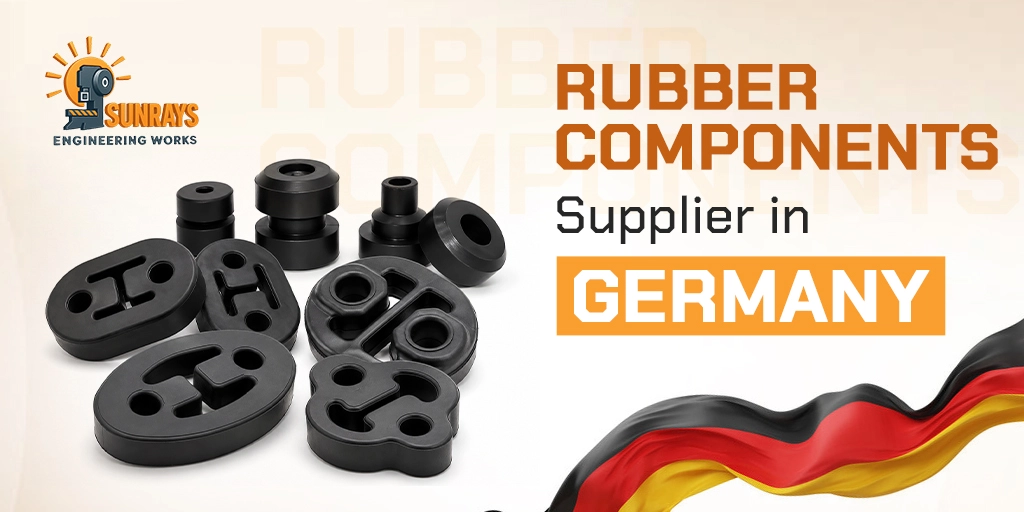
As a Rubber Components Supplier in Germany ,Rubber does a great deal of work inside a vehicle. The automotive industry uses it for sealing, vibration control, protection, mounting, insulation, and flexible connections. Many of these parts are small, yet their dimensions, material properties, surface finish, and application requirements can directly influence how an assembly performs. For manufacturers, distributors, and sourcing teams, finding a reliable Rubber Components Supplier in Germany therefore means looking well beyond a product catalogue. Material requirements, component geometry, production consistency, quality controls, documentation, packaging, and supply expectations all need to be understood before an order is placed.
Rubber parts appear across engine compartments, exhaust systems, underbody assemblies, cable routing, suspension-related applications, fluid-management areas, and other vehicle systems. Each of these uses places different demands on the part. Compound, hardness, profile, size, and resistance properties change from one application to the next. A Rubber Components Supplier in Germany working with automotive buyers needs to grasp the intended application first, then manufacture to the technical specifications the buyer has agreed.
Clamps India supports B2B buyers who are looking for automotive rubber components and related engineered parts. The company concentrates on specification-based manufacturing and export-oriented supply.
Understanding Rubber Components in Automotive Applications
Automotive rubber components are not a single product type. The category is wide. One part may simply protect a cable from abrasion, while another isolates vibration between two connected parts.
Typical examples are:
- Rubber grommets
- Rubber bushes
- Rubber seals and sealing profiles
- Rubber-lined clamps
- Rubber sleeves
- Rubber washers
- Rubber mounts
- Protective boots
- Cable and pipe protection components
- Custom-moulded rubber parts
- Rubber-metal bonded components
Even a basic component can need different material properties in a different setting. A Rubber Components Supplier in Germany serving the automotive sector has to account for temperature, contact with oils or fluids, vibration, compression, abrasion, and installation conditions, because each of these affects which material is suitable.
That is why purchasing teams tend to work from technical drawings, samples, specifications, or application details. Selecting a part by appearance alone is not enough.
Why Material Selection Matters
Rubber is a family of materials, not one material. Elastomers differ in flexibility, temperature resistance, chemical resistance, weather resistance, and mechanical performance.
For automotive parts, the compound may be EPDM, NBR, silicone, neoprene, natural rubber, or another specified material. What matters is the real service condition the part will face.
Take EPDM: it is commonly considered where weathering resistance and certain temperature conditions are the priority. NBR is often chosen when resistance to oils and fuels carries more weight. Silicone is an option for applications that need a wider temperature range, depending on the specific compound and the application.
The buyer’s material specification should be the starting point. A Rubber Components Supplier in Germany should work from it and avoid guessing based on a product name.
Material documentation, compound identification, hardness requirements, and agreed inspection parameters all help keep one batch consistent with the next. On recurring automotive programmes, the Rubber Components Supplier in Germany also needs to know which material and inspection characteristics the customer regards as critical.
Key Factors When Sourcing Rubber Components
1. Application and Operating Environment
Start by defining where the component will be fitted and what it will be exposed to. Temperature, moisture, oil exposure, vibration, compression, abrasion, and contact with other materials are the usual points to note.
With those details in hand, a Rubber Components Supplier in Germany can understand the manufacturing requirement and confirm whether the proposed material and construction really match the application.
2. Dimensions and Tolerances
In a controlled assembly, a small dimensional difference can cause a real problem. The details to specify may include inside diameter, outside diameter, wall thickness, length, profile, hole size, hardness, and dimensional tolerance.
A technical drawing gives buyer and manufacturer the same reference point. When no drawing exists, samples or clearly stated measurements can define the required geometry.
3. Hardness
Hardness plays an important role in rubber components. A customer can ask for specific hardness (such as Shore hardness) or even define an appropriate range depending on the intended use.
Choosing a correct figure would play a major role in compression, flexibility, insertion, sealing and mounting characteristics. There is a German Rubber Components Supplier that should conform to the specification.
4. Surface and Finish Requirements
Certain components need a defined surface appearance, flash control, trimming standard, or finish. Agree these points before production begins, particularly for parts that stay visible or are assembled alongside precision parts.
Written acceptance criteria remove much of the guesswork from inspection and incoming quality checks. A Rubber Components Supplier in Germany can use them as a reference for production inspection and final checks.
Custom Rubber Components for Automotive Buyers
Catalogue products cover many applications. Even so, automotive manufacturers and component distributors may also need custom rubber components.
Custom manufacturing can cover:
- A specific rubber profile
- A drawing supplied by the customer
- Special dimensions
- A defined hardness
- Material-specific requirements
- Rubber-to-metal bonding
- Moulded shapes
- Cut or formed rubber parts
- Sealing or protection components made for one application
Before production starts on a custom requirement, a Rubber Components Supplier in Germany needs to review the drawing, material specification, tolerances, quantity, tooling requirements, and inspection expectations.
A new component benefits from a sample or approval stage ahead of regular production. It gives buyer and supplier a chance to verify dimensions, fit, material, and the other agreed requirements. Once the sample is approved, a Rubber Components Supplier in Germany can use it as the reference for later production, where applicable.
Rubber Components and Clamping Applications
Clamping and mounting applications also rely on rubber. Rubber-lined clamps, protective sleeves, and rubber inserts can separate a metal clamp from the pipe, cable, or component it holds.
The rubber material and geometry are dependent upon the specific application in which the rubber parts are used. The rubber component may be required for accommodating movements, preventing metal-to-metal contacts, and protecting the supported component.
In this case, rubber parts and clamp are directly related to each other. For assembly such as mentioned above, Rubber Components Supplier in Germany is expected to consider rubber components as part of entire clamping application and not separately.
Clamps India provides automotive-oriented components, which include clamps and rubber related products, to fulfill B2B sourcing needs. Selection of the products can be based on dimensions, material, application and specifications.
Quality Considerations for B2B Sourcing
Quality control for rubber components starts with a clearly defined specification. Buyers need to identify the parameters that matter for their application before production begins.
Depending on the component, the list may cover:
- Material or compound specification
- Hardness
- Dimensional tolerances
- Visual acceptance criteria
- Weight
- Compression or fit requirements
- Bonding requirements
- Batch identification
- Packaging requirements
A Rubber Components Supplier in Germany should be able to explain how each of these parameters is controlled during manufacturing and inspection.
Batch consistency carries extra weight on repeat orders. Buyers who work with a Rubber Components Supplier in Germany may also set inspection records or batch references according to their own procurement and quality procedures.
Importance of Technical Documentation
Good documentation leaves less room for misunderstanding between an automotive buyer and a supplier. Drawings, specifications, approved samples, inspection criteria, and packaging instructions serve as a shared reference from start to finish.
For custom parts, critical dimensions and material requirements should be marked clearly in the documents. If something changes after approval, the revision needs to be controlled so that both sides are working from the same version.
Clear communication on drawing revisions, production requirements, and inspection expectations is part of the job for a Rubber Components Supplier in Germany.
Production and Supply Planning
Automotive sourcing often means repeat orders and planned production schedules. Supply planning therefore has to look past manufacturing capacity alone.
Factors that can matter include:
- Order quantities
- Tooling requirements
- Production lead time
- Raw material availability
- Inspection time
- Packaging
- Shipping documentation
- Delivery schedules
Tooling may be needed for custom rubber components before regular production can start. Tooling ownership, development samples, approval stages, and production planning are best discussed at the very beginning of the project.
Delivery and production information from a Rubber Components Supplier in Germany should be realistic and based on the agreed specification and order requirements.
Packaging and Export Considerations
Rubber components could be packaged in an appropriate way to ensure that their shape, surface and cleanness are maintained while being moved around. Packaging requirements vary depending on the size, number, nature of the components and the customers’ demands.
Labels for the purpose of identification and stock control in international business-to-business supply chain could be included in the packaging.
Buyers sourcing from an international Rubber Components Supplier in Germany should also settle documentation requirements, shipping terms, packaging specifications, and any customer-specific labelling instructions before dispatch.
Why Automotive Buyers Work With Specification-Based Suppliers
A specification-based supplier builds on defined technical requirements instead of generic product descriptions. This works well when a component belongs to an established vehicle assembly, or when a replacement part must match an existing design.
Ideally, a Rubber Components Supplier in Germany can discuss each of these with the buyer:
- Drawing-based production
- Material requirements
- Dimensional tolerances
- Sampling and approval
- Quality inspection
- Repeat-order consistency
- Packaging
- Export documentation
- Customisation requirements
The point is not just to buy a rubber part. A Rubber Components Supplier in Germany should support a sourcing process where the approved component specification stays clear through quotations, samples, production, and repeat orders.
Clamps India's Approach to Automotive Rubber Components
Clamps India serves B2B customers who want automotive components made to defined product and application requirements. The range includes clamps, rubber components, exhaust-related components, and other engineered parts for automotive and industrial use.
For rubber components, sourcing can begin from product drawings, dimensions, material requirements, samples, and application information. The manufacturing requirement can then be discussed before production, and the parameters that must be maintained can be established.
Clamps India is an export-oriented supplier, so packaging and documentation requirements for international B2B orders are part of its planning. For buyers comparing a Rubber Components Supplier in Germany, these practical supply factors can carry as much weight as the component itself.
Conclusion
To sum up, rubber parts procurement for automotive purposes implies that there must be an appropriate match between component and its application, specification, and logistics needs.
Therefore, a reliable Rubber Components Supplier in Germany must be capable of dealing with a properly elaborated specification of technical characteristics and providing the whole chain of processes concerning manufacturing, quality control, sampling, and logistics planning. In case of international sourcing, practical aspects, including communication issues, export documentation, packaging, and production planning, become essential for building up the trustful business-to-business relations.
Clamps India offers automotive and industrial buyers specifications-oriented rubber parts and clamps, as well as other engineering products. In case of specifying components via drawings, samples, dimensions, material types, quantities, and applications, the whole sourcing process can be organized in accordance with real buyer’s needs. Therefore, Clamps India will be able to help German companies that are in search of an exporter of automotive rubber parts, clamps, and various engineered products, who manufacture their products through drawings, samples, dimensioning, materials required, and applications.
frequently asked questions
1. What rubber components can a buyer of automobiles get from a vendor based in Germany?
Rubber bushing, rubber grommet, rubber seal, rubber sleeve, rubber mount, rubber damper, rubber parts for vibration damping, and rubber parts suitable for the specific use of automobiles can be acquired.
2. Is it possible to order customized components from the Rubber Components Supplier in Germany?
The development of customized rubber components is possible on the basis of the application needs, drawings, sizes, materials, and other criteria. The buyer must present the technical data about the component.
3. What quality information can be requested from the supplier of rubber components?
The buyer might ask for the following information: material, size, inspection, testing, manufacturing and tracing information.
4. What do automotive buyers need to consider when purchasing rubber components abroad?
Buyers need to consider the product specifications, material homogeneity, quality control process, packaging, production capacities, documentation procedures, lead times, and export procedures among other aspects. Technical communication becomes very crucial when ordering customized parts.
5. Why is it important to choose an experienced Rubber Components Supplier in Germany in automotive applications?
The experienced supplier can assist buyers to handle technical specifications, materials, dimensions, quality controls, and production needs in a systematic manner. This helps buyers when ordering the same components repeatedly.