Sourcing exhaust clamps sounds simple until you’ve actually done it at scale. Anyone who has run a procurement cycle for automotive fasteners knows that a clamp isn’t just a piece of bent metal — it’s a component that has to survive heat cycling, road vibration, moisture, and years of service without failing at a joint. So when an Italian OEM, Tier-1 supplier, or aftermarket distributor starts looking for a new Exhaust Clamps supplier in Italy, the decision usually comes down to one question: can this vendor be trusted with a recurring, high-volume order?
Clamps India has spent years answering that question for automotive buyers across Europe. Based in India and built specifically for export, the company has grown into a dependable Exhaust Clamps supplier in Italy for manufacturers who need consistency batch after batch, not just a good first sample. This article walks through what exhaust clamps actually do, what separates a reliable supplier from a risky one, and why so many Italian businesses have added Clamps India to their approved vendor list.
This guide is written for the people who actually sit through vendor evaluations — procurement managers, quality auditors, and sourcing teams comparing more than one Exhaust Clamps supplier in Italy before signing off on a purchase order
What Exhaust Clamps Do — and Why the Small Details Matter?
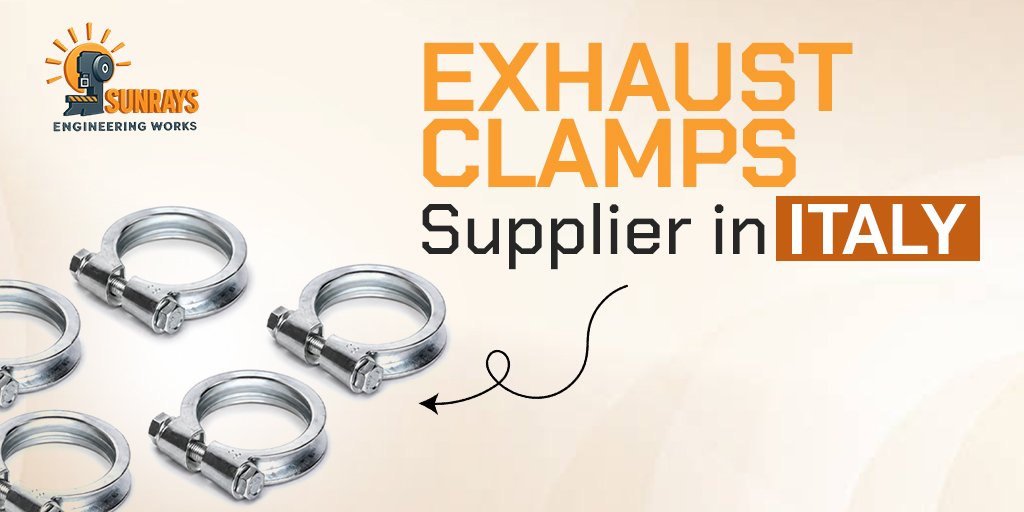
An exhaust clamp holds two sections of a vehicle’s exhaust system together — pipe to muffler, muffler to resonator, resonator to tailpipe. It looks like a minor part of a drawing. In practice, it’s the thing standing between a properly sealed exhaust and a leak that shows up as noise, lost torque, a check-engine light, or a failed emissions test. Get the clamp wrong — wrong grade, wrong tolerance, wrong coating — and the problem doesn’t show up on day one. It shows up six months later, in the field, as a warranty claim.
That’s really the whole case for working with a serious Exhaust Clamps supplier in Italy: the cost of a bad clamp is never just the clamp.
The Product Range we manufacture
- U-Bolt Exhaust Clamps — the standard workhorse for pipe-to-pipe joints
- Band Clamps — wrap fully around the joint for a more even, leak-resistant seal
- V-Band Clamps — used where turbo pressure or high heat demands a tighter, more uniform clamping force
- Saddle Clamps — common on muffler and tailpipe fittings
- Preformed / Custom Clamps — built to match a specific OEM exhaust geometry
Manufacturing across all five categories under one roof is what lets us function as a single-point Exhaust Clamps supplier in Italy for buyers who’d otherwise have to juggle two or three vendors for different clamp types.
Key Challenges in Sourcing Automotive Pipe Connectors
Evaluating a new Exhaust Clamps supplier in Italy is rarely a one-meeting decision, and it shouldn’t be.
Italy’s automotive sector is dense and demanding — OEM assembly plants, component integrators, and a huge network of independent workshops all pulling from the same category of hardware. That volume creates real opportunity for a good supplier and real risk for a careless one.
Buyers who’ve been through a bad vendor relationship usually list the same five complaints:
- Material quality that varies from one batch to the next
- Shipments that arrive late enough to stall a production line
- EU compliance checks show bad documentation
- No wish to have a non-standard exhaust design custom-made
- MOQs set for large buyers, locking out mid-sized companies
None of these are exotic problems — they’re the ordinary, avoidable failures that come from picking a supplier on price alone. A properly vetted Exhaust Clamps supplier in Italy should be able to speak directly to each of these points with documentation, not just reassurance.
How We Approach Quality as an Exhaust Clamps Supplier in Italy?
We are not a trading company repackaging someone else’s output — it runs its own manufacturing operation, and that ownership shows up in how quality is controlled at each stage.
- Material Selection
Depending on the application, clamps are produced in stainless steel (SS201, SS304, SS316), electro-galvanized mild steel, or zinc-plated carbon steel. The choice isn’t arbitrary — a clamp destined for a coastal or high-salt environment needs a different corrosion profile than one built for dry inland use, and the team sizes material grade to the actual operating conditions rather than defaulting to whatever’s cheapest.
- Precision in Production
Forming, punching, and bending are handled on CNC-controlled equipment, which keeps dimensional variance tight across a production run. For an OEM assembly line, that consistency matters more than almost anything else — a clamp that’s a fraction of a millimeter off spec can jam a fitting station and cost far more in downtime than the part itself is worth.
- Testing Before Anything Ships
Every batch goes through salt-spray testing, tensile strength checks, and torque-load verification before it leaves the facility. This is the part of the process a lot of buyers never see, but it’s the part that actually determines whether a clamp holds up on a vehicle two years and forty thousand kilometers later. It’s also, frankly, the reason we can call ourselves a credible Exhaust Clamps supplier in Italy rather than just another name in a supplier directory.
- Custom Tooling for Non-Standard Designs
Italian vehicle platforms don’t all use the same pipe diameter, band width, or torque rating, and buyers shouldn’t have to compromise their design just to fit whatever an Exhaust Clamps supplier in Italy already has sitting in stock. Developing custom tooling on request, which is why several long-term clients treat the relationship less like a transaction and more like an extension of their own engineering team.
Key Reasons Italian Buyers Are Sourcing from India
This isn’t a new trend, but it has accelerated, and it’s part of why demand for a dependable Exhaust Clamps supplier in Italy keeps growing rather than leveling off. Indian manufacturing offers a genuine cost advantage over several established sourcing regions, and the gap has narrowed the quality-versus-price tradeoff that used to make buyers hesitant.
- Competitive Costs Without Cutting Corners
Lower production and labor costs in India translate into better landed pricing for Italian buyers — without forcing a choice between price and material integrity, provided the supplier actually invests in testing and process.
- Capacity That Scales With the Order
A first order might be a few thousand units for evaluation. A year later, it might be a recurring monthly requirement in the hundreds of thousands. Our production setup is built to absorb that growth without pushing lead times out to unmanageable levels.
- Export Paperwork Handled, Not Outsourced Back to You
Anyone who has dealt with customs delays knows how much friction sits in the documentation, not the product. Managing export certification, packaging compliance, and shipping paperwork as part of the standard order process, which takes a genuine administrative load off the buyer’s team.
- Shipping That Doesn’t Become the Weak Link
Container-load and part-load options, coordinated freight scheduling, and consistent dispatch timing round out what makes us a logistically trustworthy Exhaust Clamps supplier in Italy — the kind that won’t turn a routine reorder into a supply chain emergency
Who Actually Buys From This Exhaust Clamps Supplier in Italy?
- Automotive OEMs beginning new production lines needing spec-matched clamps in volume, with the ability to input design changes rather than accept off-the-shelf.
- Tier-1 and Tier-2 component suppliers assembling complete exhaust systems under an OEM contract, where a missed shipment upstream becomes their problem downstream.
- Aftermarket and spare parts distributors who need dependable, reasonably priced stock for repair and replacement work across passenger and commercial vehicles.
- Fleet and commercial vehicle operators running trucks and heavy vehicles that put far more stress on exhaust hardware than a typical passenger car, and need clamps built for that.
What Actually Separates us From a Generic Exporter?
It’s tempting to assume every export-focused manufacturer offers roughly the same thing, but the differences show up quickly once you start comparing vendors seriously.
Manufacturing Is In-House, Not Subcontracted
Controlling its own production floor, there’s no middleman diluting quality control or adding an extra markup with no added value. That direct control is what allows the company to actually stand behind its role as an Exhaust Clamps supplier in Italy, rather than reselling someone else’s inconsistent output.
Communication That Doesn’t Disappear After the Sale
Export orders get assigned a dedicated account contact who handles specifications, sample approvals, and shipment tracking — someone a buyer can actually reach when a question comes up mid-production, not a rotating support inbox.
Samples Before Commitment
New partners are encouraged to test samples independently before placing a bulk order. It’s a small thing, but it signals confidence in the product rather than pressure to close a deal quickly.
A Genuine Long-Term Fit, Not Just a One-Time Vendor
Buyers who’ve worked with more than one Exhaust Clamps supplier in Italy often say the same thing: the first order tells you about the product, but the second and third orders tell you about the company.
Built for Repeat Business, Not One-Off Orders
The pricing structure and production planning are set up to reward long-term buyers with priority scheduling and pricing stability, because a single large order is worth far less to either side than a relationship that runs for years.
Packaging and Traceability From a Dependable Exhaust Clamps Supplier in Italy
Good sourcing decisions don’t end at the factory gate. Every consignment goes out in export-grade, moisture-resistant packaging built to survive long sea transit without the product corroding or the finish getting damaged in transit. Cartons carry batch numbers, production dates, and material grade information, so buyers can trace any unit back to its production run if their own quality system ever needs it.
If something does go wrong with a batch — and in manufacturing, it occasionally does — the export team investigates directly with the buyer and issues replacements where the issue is confirmed, rather than treating it as the buyer’s problem to absorb. That’s usually the moment that determines whether a first-time buyer becomes a recurring one.
Planning Around Lead Times
Standard clamps with existing tooling move faster than fully custom designs, which need tooling development before the first production run. Working with buyers during the planning stage — not after an order is already late — to align production against the buyer’s own assembly schedule.
A Word on Sustainability
EU procurement teams increasingly have to account for supplier sustainability as part of their own compliance reporting, and Italy is no exception. Running operations with efficient material use, controlled effluent handling, and recyclable packaging wherever it’s practical to do so. It’s not a marketing claim — it’s simply become part of what a responsible manufacturing partner is expected to do, and buyers evaluating a new Exhaust Clamps supplier in Italy are right to ask about it.
Conclusion: A Supplier of Exhaust Clamps in Italy Worth Shortlisted
In the automotive supply chain, component reliability is not a nice-to-have. It directly affects production uptime, warranty costs and end-customer safety. Clamps India combines precision manufacturing, verified material compliance, competitive export pricing, and a logistics track record that stands up to real-world order volumes. If you are a component assembler, parts distributor or an Italian automotive manufacturer searching for a new Exhaust Clamps supplier in Italy, then the most logical next step will be to request a sample batch and view the technical documentation directly.
Frequently Asked Questions
1. What’s the best material for exhaust clamps, honestly?
Depends on where the vehicle spends its life. Stainless steel and zinc-plated carbon steel cover most cases, but if you’re dealing with coastal routes or heavy road salt, it’s worth pushing for the higher-grade stainless rather than defaulting to whatever’s cheapest.
2. How do I figure out what size clamp I actually need?
Measure the outer diameter of the pipe right at the joint — that’s the number that matters. Most manufacturers can hand you a sizing chart in millimeters, but if your setup is even slightly non-standard, it’s faster to just send the measurement directly and ask.
3. Do exhaust clamps come universal, or do they have to match the vehicle?
A bit of both. U-bolt and band clamps fit a wide enough range of standard pipe diameters that they work across a lot of vehicles. But if you’re working on an OEM platform with its own geometry, you’re usually looking at a custom-engineered clamp instead.
4. What’s actually different between a U-bolt clamp and a V-band clamp?
A U-bolt clamp is the simpler setup — a U-shaped bolt tightened over a bracket, fine for general-purpose joints. A V-band clamp spreads the clamping force more evenly around the whole joint, which is why it’s usually the one you’d reach for on a turbocharged or high-heat system.
5. How long does a decent exhaust clamp actually last?
Several years, if the material grade is right and it’s torqued correctly on installation. That said, road salt, constant vibration, and climate will all wear it down faster than a spec sheet suggests, so treat “years” as a range, not a guarantee.
6. Can I get exhaust clamps customized for a large order?
Yes, and most serious manufacturers will do it — band width, torque rating, coating, all of it can be adjusted once the order volume justifies developing new tooling. Worth asking early, since custom tooling adds lead time up front.
7. What should I actually check before trusting an exhaust clamp exporter?
Ask for ISO certification, material test certificates, and export paperwork that’s genuinely built for EU compliance — not a vague quality statement on a website. If a supplier can’t produce this documentation on request, that’s usually the answer right there.
8. Why are so many Italian companies sourcing exhaust clamps from India now?
Mostly because the old tradeoff — lower cost, lower quality — doesn’t really hold anymore. Indian manufacturers who’ve invested in proper testing and process control can meet the same compliance standards while still landing at a better price than a lot of traditional sourcing regions.