Most rubber part failures don’t come from the shape of the part. They come from the compound. A hanger that looks right on the drawing cracks after one winter, or a clamp lining softens after a few months near an oil line. If you are looking for a rubber components supplier in Netherlands, the first thing worth settling is what the part has to survive, and only then the price.
This guide covers what Clamps India supplies, how rubber materials differ, how custom rubber components work, and what to put in your first enquiry so the quote you get back is useful. It is written for buyers who want a rubber components supplier in Netherlands that can handle both automotive rubber components and industrial parts without guesswork.
Rubber Components Supplier in Netherlands for Buyers
Buyers in the Netherlands tend to be specific. Many work with distribution networks, vehicle fleets, port equipment, horticulture machinery or building services, and they expect parts to match a drawing or a sample exactly. They also deal with EU import rules, so they usually want to know early what documents come with the shipment. For these buyers, choosing a rubber components supplier in Netherlands is as much about clear communication and documentation as it is about the part itself.
Clamps India is the export-facing brand of Sunrays Engineering Works, a rubber components manufacturer in India that also makes exhaust clamps, V band clamps and pipe connectors. Manufacturing has been running continuously since 1985, under founder Mr. Pradeep Goyal, and the company already works with buyers across Asia, Europe, Australia and North America. Its rubber range covers automotive rubber components, industrial rubber components and custom rubber components, so a single enquiry can cover all three. That matters if you would rather buy related parts from one place.
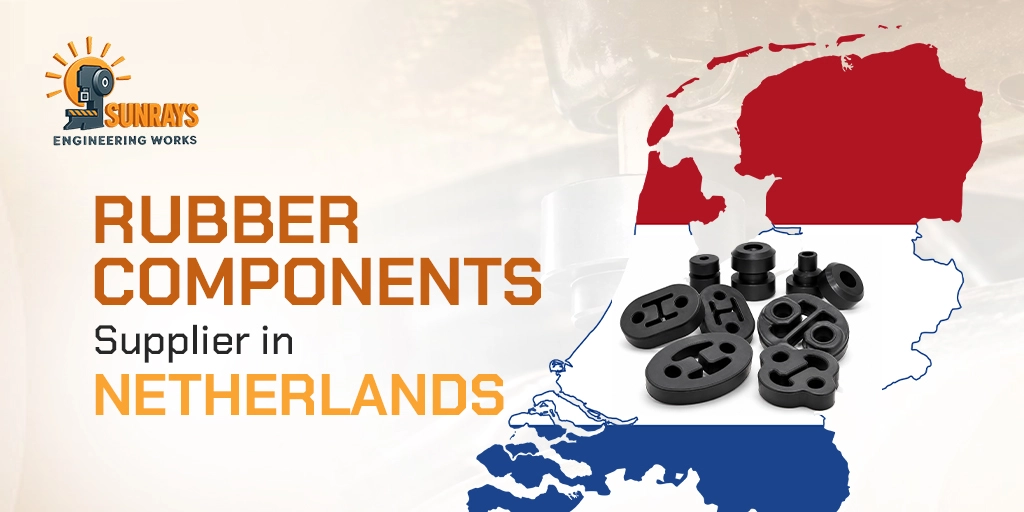
Rubber Components We Supply
Anyone searching for a rubber components supplier in Netherlands usually has one of the five product types below on the list.
Rubber Hangers
A rubber hanger holds a pipe, most often an exhaust, under a vehicle and still lets it move a little. It is one of the simplest automotive rubber components, and one of the easiest to get wrong. The rubber absorbs engine vibration so it doesn’t travel into the body as noise. Hangers differ in length, hole spacing and hardness. One that is too stiff passes vibration straight through, and one that is too soft lets the pipe sag over time. If you are replacing an existing hanger, sending the old one is the quickest way to get the match right.
Rubber-Lined Clamps
These are metal clamps with a rubber strip bonded or fitted on the inside. They hold hoses, pipes, tubes and cables. The lining stops metal rubbing against the line it holds, which is what slowly wears through hoses and cable sheathing, and it also dampens vibration. When you specify one, give the outer diameter of the line being held. The lining compresses when the clamp is tightened, so the nominal clamp size alone can mislead.
Rubber P-Clamps
The name comes from the shape: a loop with a flat tail. The loop goes round the line, and the tail is bolted to a bracket or panel. A rubber cushion sits inside the loop. P-clamps are common on fuel lines, brake lines, wiring harnesses, hydraulic hoses and conduit. For an accurate quote you need the inner diameter, band width, bolt hole size and the band material. If the clamp will sit in a salty or damp environment, such as near the coast or on marine equipment, mention it so the right metal finish can be discussed.
Rubber-Metal Components
Here the rubber is bonded to a metal part during vulcanisation. Engine mounts, exhaust mounts, bushings, buffers and vibration isolators are typical examples, and the same idea carries over to industrial rubber components such as pump and compressor mounts. The bond is the critical point, because if the rubber peels from the metal the part is finished. Tell the supplier whether the part works in compression, shear or both, and whether the load is steady or keeps cycling. Those details decide the rubber hardness and the shape of the part.
Custom Rubber Components
If your part isn’t a standard catalogue item, it can be made to your drawing, sample or written specification. The details are covered in the custom section below.
Rubber Materials for Different Applications
Picking the compound is where most of the real decisions happen, and any rubber components supplier in Netherlands you speak to should be ready to talk through it. The table below is a simple guide. Exact temperature limits and chemical resistance vary by compound and formulation, so ask for the figures for the specific compound quoted.
Material | Where it works well | What to watch |
EPDM | Weather, ozone, water, coolant, steam | Poor with petroleum oils and fuels |
NBR (nitrile) | Oils, fuels, hydraulic fluids | Weaker against ozone and long outdoor exposure |
CR (neoprene) | Moderate oil and weather resistance, general use | Not the best at either extreme |
Silicone | Wide temperature range, clean applications | Lower tear strength, not suited to fuels and oils |
FKM | High heat, fuels, aggressive chemicals | Costs noticeably more |
Natural rubber | Elasticity, vibration damping, fatigue life | Poor with oils and ozone |
A quick way to think about it: if the part sits outdoors and meets water, EPDM is usually the first candidate. If it sits next to oil or fuel, look at NBR or FKM. The same logic applies to industrial rubber components working near hydraulic lines. If it mostly has to flex and damp vibration, natural rubber is worth a look. When a part sees more than one of these, such as heat plus oil, the decision gets harder, and that is the case where a conversation with the supplier before ordering saves a lot of trouble. If you are unsure, tell Clamps India the working conditions and ask for a recommendation before you order.
Also tell the supplier the hardness you need, usually given in Shore A. Two parts of the same shape and different hardness behave very differently in service.
Custom Rubber Components for Dutch Businesses
Standard parts cover a lot, but many Dutch OEMs, distributors and maintenance teams end up needing something slightly different: another length, another cross-section, a different compound. That is where custom rubber components come in. When you compare a rubber components supplier in Netherlands for this kind of work, check whether they accept all three of the starting points below. Clamps India takes drawing-based, sample-based and specification-based enquiries.
From a Drawing
A dimensioned drawing with tolerances, material and hardness is the cleanest route. PDF or CAD files are both fine. If some dimensions are critical and others aren’t, mark which is which. It helps the supplier quote sensibly.
From a Sample
If you have a worn or working part and no drawing, send the sample. The supplier can measure it, assess the compound and propose a match. A used sample can mislead on hardness since rubber ages, so add a note on what the part does and where it sits.
From a Specification
When you only have performance needs, for example oil resistance, a certain load or a space limit, write those down. A specification gives enough to propose a design, but expect more back-and-forth than with a drawing.
Custom shapes often need a new mould, which affects cost and lead time. Whichever rubber components supplier in Netherlands you choose, ask directly about this instead of assuming, and ask about minimum order quantities for custom items as well.
Applications of Rubber Components
Rubber hangers, clamps and bonded parts turn up in more places than most buyers first list, so it helps to tell your rubber components supplier in Netherlands exactly where yours will be used:
- Passenger cars and commercial vehicles: automotive rubber components such as exhaust hangers, plus clamps for fuel and brake line routing and engine bay hoses
- Trailers and truck bodies, where vibration is constant
- Agricultural and horticultural machinery, which the Netherlands has plenty of
- HVAC and building services: pipe and duct supports that need to stop noise travelling through a structure
- Marine, port and water-handling equipment, where hoses and cables sit in damp and salty conditions
- General industrial machinery, pumps and compressors, where industrial rubber components such as mounts and buffers protect both the machine and its surroundings
Food-related equipment needs extra care. If the part could touch food or is used near food processing, say so, and confirm that the compound and its documentation fit your requirements before ordering.
Why Netherlands Buyers Source Rubber Components from Clamps India
There are a few honest reasons a buyer looking for a rubber components supplier in Netherlands would shortlist Clamps India.
The first is time in the business. Sunrays Engineering Works has been manufacturing since 1985, and the export side, Clamps India, already serves buyers in Europe among other regions. That means the export paperwork and communication side is familiar ground, not a new experiment.
The second is the range. Automotive rubber components and industrial rubber components, from rubber hangers and lined clamps to P-clamps and rubber-metal parts, come from a company that also makes exhaust clamps, V band clamps and pipe connectors. For a distributor or workshop supplier, buying related parts together can mean fewer suppliers to manage and simpler shipment planning.
The third is flexibility on custom work. Drawing-based, sample-based and specification-based enquiries are all accepted, so you aren’t limited to a fixed catalogue of custom rubber components.
One practical point. Sourcing from India means transit time sits between your order and your shelf. It doesn’t make the process difficult, but it does reward getting the specification and samples right at the start, so you don’t lose weeks to avoidable corrections.
If your shortlist for a rubber components supplier in Netherlands comes down to fit, range and flexibility, those three points are where Clamps India is worth a closer look.
Rubber Component Supply for Automotive and Industrial Applications in the Netherlands
The Netherlands has a dense logistics network, with Rotterdam among Europe’s largest ports, and that shapes how buyers here judge any rubber components supplier in Netherland. Goods arriving from outside the EU move through customs, so it helps to agree the shipping terms (FOB, CIF, DAP or similar) in the quote itself, along with who handles import clearance.
For automotive buyers, whether aftermarket distributors, exhaust specialists, importers or fleet operators, the focus is usually on fit, repeat availability and consistent quality batch to batch. Automotive rubber components like hangers and P-clamps tend to be bought again and again, so when you compare a rubber components supplier in Netherlands for repeat orders, ask how they handle part numbering and batch consistency. Sharing your expected yearly volume, even roughly, helps the supplier plan production and often leads to a more sensible quote than one built on a one-off order.
For industrial rubber components, the operating environment comes first: fluids, temperature, outdoor exposure and vibration. A rubber components supplier in Netherlands can only recommend the right compound if it knows these details, so share them in the first message. It’s far easier to choose the right compound with that information than to correct a failed batch later.
Ask early about the documents you need. Depending on your application, that might include material information or compliance statements relevant to EU rules such as REACH. Whatever you need, put it in the enquiry rather than raising it after production.
How to Send a Rubber Component Enquiry
A clear enquiry gets a faster and more accurate reply, whichever rubber components supplier in Netherlands you approach. Include as many of these as you can:
- The part type: hanger, rubber-lined clamp, P-clamp, rubber-metal part or custom item
- A drawing, a sample or a written specification
- Key dimensions, including inner and outer diameters, length, width and bolt hole size where relevant
- The rubber material, or if you don’t know it, the working conditions: temperature, oils, fuel, weather, vibration
- Hardness in Shore A, if known
- The metal part’s material and finish, for clamps and bonded parts
- First order quantity and expected yearly quantity
- Delivery location in the Netherlands and your preferred shipping terms
- Any documents or compliance information you require
- Packaging or labelling needs
- Your target delivery timeline
For automotive rubber components, add the vehicle make, model and any OEM part number you have. For industrial rubber components, add the machine type and the conditions it runs in. For custom rubber components, a drawing or sample matters more than anything else on this list.
After that, the supplier reviews the information, may come back with technical questions, and then sends a quotation. For custom parts, a sample approval step before bulk production is worth requesting. Use the enquiry form or contact details on the Clamps India website to start.
Conclusion
Buying rubber parts is easier when the supplier knows what the part has to do. Give the working conditions, the dimensions and the quantity, and the rest is a conversation instead of guesswork. If you are comparing options for a rubber components supplier in Netherlands, send Clamps India a drawing, sample or specification and see how the reply compares. Whether you need automotive rubber components, industrial rubber components or custom rubber components, a well-briefed enquiry is what turns a search for a Rubber Components Supplier in Netherlands into a working supply arrangement.
Frequently Asked Questions
What rubber components can I source from Clamps India for the Netherlands?
The range for anyone looking for a rubber components supplier in Netherlands includes rubber hangers, rubber-lined clamps, rubber P-clamps, rubber-metal components and custom rubber components made to a drawing, sample or specification.
Can I order custom rubber components without a drawing?
Yes. You can send a sample or a written specification instead. A drawing makes the process faster, but a sample or clear performance requirements is enough to begin.
How do I choose between a P-clamp and a rubber-lined clamp?
A P-clamp is bolted to a surface through its tail and suits fixed routing of hoses, lines and cables. A rubber-lined clamp is usually a band or saddle that holds a pipe or tube, often around a support. The right pick depends on how the line is mounted, so send your layout or a photo if unsure.
Which rubber is best for oil or fuel contact?
NBR is commonly used where oils and fuels are present, and FKM for tougher chemical or heat conditions. EPDM and natural rubber generally do poorly with petroleum products, so avoid them in those places.
What information does a rubber components supplier in Netherlands need to give a quotation?
Part type, dimensions, material or operating conditions, quantity, delivery location and any documents you need. A drawing or sample speeds it up considerably.
Can rubber components be ordered together with exhaust clamps or pipe connectors?
Clamps India also makes exhaust clamps, V band clamps and pipe connectors, so related items can be enquired about together. Mention everything in the same enquiry so shipping can be planned in one go.
Do I need to worry about EU compliance when choosing a rubber components supplier in Netherlands?
It depends on the application. Some uses, such as food contact or specific industrial sectors, carry requirements. Tell the supplier what you need at enquiry stage and ask for the relevant documents before you place the order.
How does Clamps India work as a rubber components supplier in Netherlands, and how does shipping work?
Clamps India manufactures in India and ships to buyers in the Netherlands. Terms are agreed per order. Specify whether you want FOB, CIF, DAP or another arrangement, the delivery point, and who handles customs clearance. Plan transit time into your stock schedule.